
/ / / / / / / / / / / / / / /EST. 2025 / / CHICAGO, IL
+
+
+
Morton Labs Is
The Multi-Physics Ecosystem Making Innovation Accessible
Access, develop, sell, and license the world's most advanced scientific simulation software.
Simulate. Innovate. Accelerate.

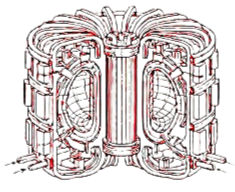
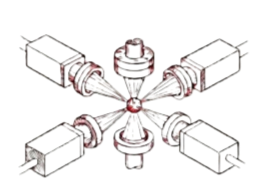


Building the Computational Backbone of Fusion Energy
With the rise of artificial intelligence and increased data center demand, the world is facing an international power supply shortage. Nuclear Fusion is poised to be the silver bullet.

Fusion is a “when,” not an “if”
In recent years, aided by novel technologies such as high-temperature superconductors, the transition from scientific curiosity to heavy engineering has been fueled by a massive influx of private capital ($10B +) and a shift in viewing fusion as a commercial reality rather than a laboratory experiment.
The narrative around fusion has also shifted from academic "if" to industrial "when." In 2026, we are seeing the first generation of privately funded, grid-scale prototypes move from blueprints to testing.
However, this shift has exposed a massive vulnerability: the software tools used to design these billion-dollar machines were never built for the pace of private industry. They were built for researchers, by researchers.

The Software Bottleneck
Software tools used to design today’s fusion generators were originally developed for the unique needs of academic and national laboratory research. These high-fidelity codes were built for scientific exploration and discovery, where flexibility and depth of physics take precedence over industrial speed or autonomous optimization. However, as the industry moves toward grid-scale deployment, a gap has emerged between the requirements of deep research and the demands of commercial engineering.

Another emerging challenge is the alignment of legacy data with artificial intelligence. Advanced development increasingly relies on machine learning to accelerate discovery, yet AI models require clean, structured, and consistent data schemas. Many foundational codes produce results in unstructured formats that vary between institutions, creating a "dark data" problem. To move at the speed of modern AI, fusion engineering requires a common data language that transforms these sophisticated research outputs into a standardized foundation for machine learning and commercial-grade digital twins.

Our Mission
To bridge the gap between discovery and deployment, Morton Labs serves as the commercialization layer for fusion software. We specialize in the critical process of taking high-fidelity research codes and hardening them for the rigors of commercial R&D. Our team works alongside creators at universities and national laboratories to update legacy architectures, optimize solvers for modern GPU and exascale computing clusters, and implement the rigorous verification and validation standards required for billion-dollar hardware projects. By assuming the burden of software maintenance and optimization, we allow the world’s leading physicists to stay focused on delivering power to the grid.
Our Ecosystem
Morton Labs operates as a specialized software ecosystem designed to unlock the value of global physics intellectual property. We provide a platform where research institutions, private companies, and independent code creators can monetize their high-fidelity tools. Through our model, we handle the complex tasks of licensing, distribution, and commercial-grade development, while ensuring that a significant portion of every sale is returned to the original developers as royalties. This ecosystem aligns the incentives of academia and industry, turning trapped research into a sustainable revenue stream for laboratories and a turnkey competitive advantage for private fusion companies.

Strategic Value
For private fusion enterprises, Morton Labs represents a massive acceleration of time-to-market. Historically, a startup might spend years and millions of dollars building an internal software department just to manage and integrate research codes. By plugging into our ecosystem, these firms gain immediate access to a suite of commercial-grade, interoperable tools that are already optimized for the latest AI and hardware architectures.
Contact Us
Want to learn more about Morton Labs and our multi-physics modeling platform? Send us a message below to schedule a call!